 |
Four Famous Sculptures of David in Renaissance Art
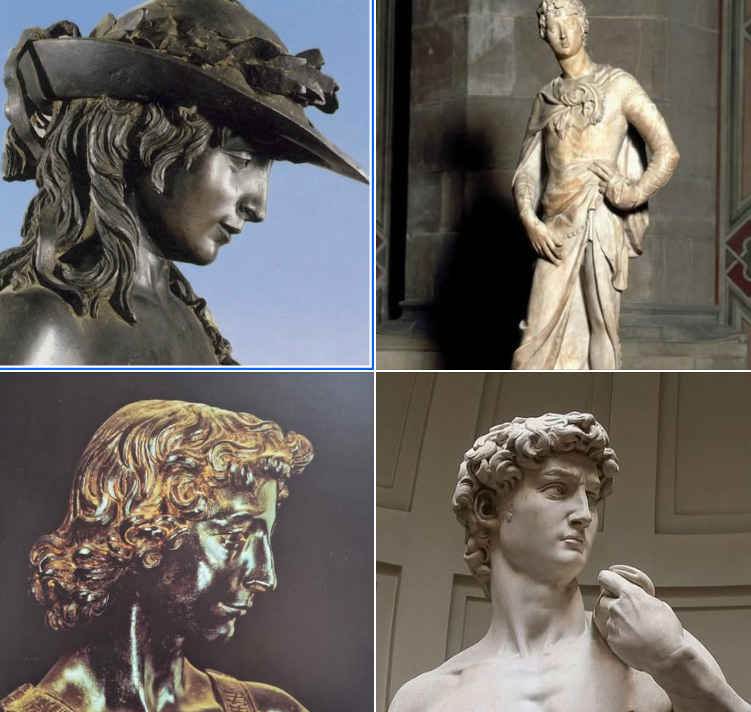
The biblical hero David, the young shepherd who defeated the giant warrior Goliath with only a sling and a stone, became one of the most powerful symbols of courage and faith in Renaissance art.
For the people of Florence, David represented something even deeper. The small but determined Republic of Florence adopted him as a symbol of the city’s strength and resilience against larger and more powerful enemies. Because of this symbolism, several Renaissance masters created sculptures of David, each interpreting the hero in a different way.
Among the most famous are four sculptures created during the Renaissance: two by Donatello, one by Andrea del Verrocchio, and the monumental masterpiece by Michelangelo.
Donatello's Bronze David

Donatello’s bronze David, created around 1440–1442, was commissioned privately by the powerful Medici family. This sculpture is historically important because it was the first freestanding male nude bronze statue created since classical antiquity.
The figure of David appears youthful and delicate. He stands wearing only a shepherd’s hat and armorial greaves that protect his legs. Beneath his feet lies the severed head of Goliath, confirming his victory. The sculpture reflects both classical influences and the emerging humanist ideals of the Renaissance.
Donatello's Marble David

Donatello had earlier created another version of David in marble around 1412. This statue stands about 6 feet 3 inches (1.9 meters) tall and presents a very different interpretation of the hero.
In this version David is fully clothed in a long robe. He stands confidently over the decapitated head of Goliath, looking straight ahead after the battle.
The base of the sculpture carries a Latin inscription which translates to: “To those who fight bravely for the fatherland, the gods lend aid even against the most terrible foes.” The message reinforced Florence’s belief that courage and determination could overcome even the strongest opponents.
Verrocchio's Bronze David

Andrea del Verrocchio created another famous bronze statue of David later in the 15th century. In this version David appears as a confident young boy standing proudly over the head of the defeated Goliath.
The sculpture is notable for its naturalistic detail and expressive features. Art historians have often suggested that the face of David may have been modelled on the young Leonardo da Vinci, who was an apprentice in Verrocchio’s workshop at the time.
Whether or not this theory is correct, the statue demonstrates the elegance and refinement typical of Florentine Renaissance sculpture.
Michelangelo's David

The most famous sculpture of David was created by Michelangelo between 1501 and 1504. Unlike earlier versions that show the hero after defeating Goliath, Michelangelo chose to depict the moment before the battle.
The towering marble statue stands more than 17 feet (5 meters) tall and represents the ideal of human physical perfection. Every muscle and anatomical detail is carefully carved, demonstrating Michelangelo’s extraordinary understanding of the human body.
This David embodies the Renaissance ideal of strength, beauty and intellectual courage. When it was unveiled in Florence, the sculpture quickly became one of the greatest masterpieces of Renaissance art.
David as a Renaissance Symbol
Each of these sculptures reflects a different moment in Renaissance artistic development. Donatello’s works mark the early rediscovery of classical sculpture, Verrocchio’s statue represents the refined naturalism of the later 15th century, and Michelangelo’s David stands as the ultimate expression of Renaissance ideals.
Together, these four sculptures show how one biblical story inspired generations of artists and became one of the most enduring symbols of courage, faith and human potential in Western art.
Art Movement: Renaissance