 |
Leonardo da Vinci – The Virgin and Child with Saint Anne
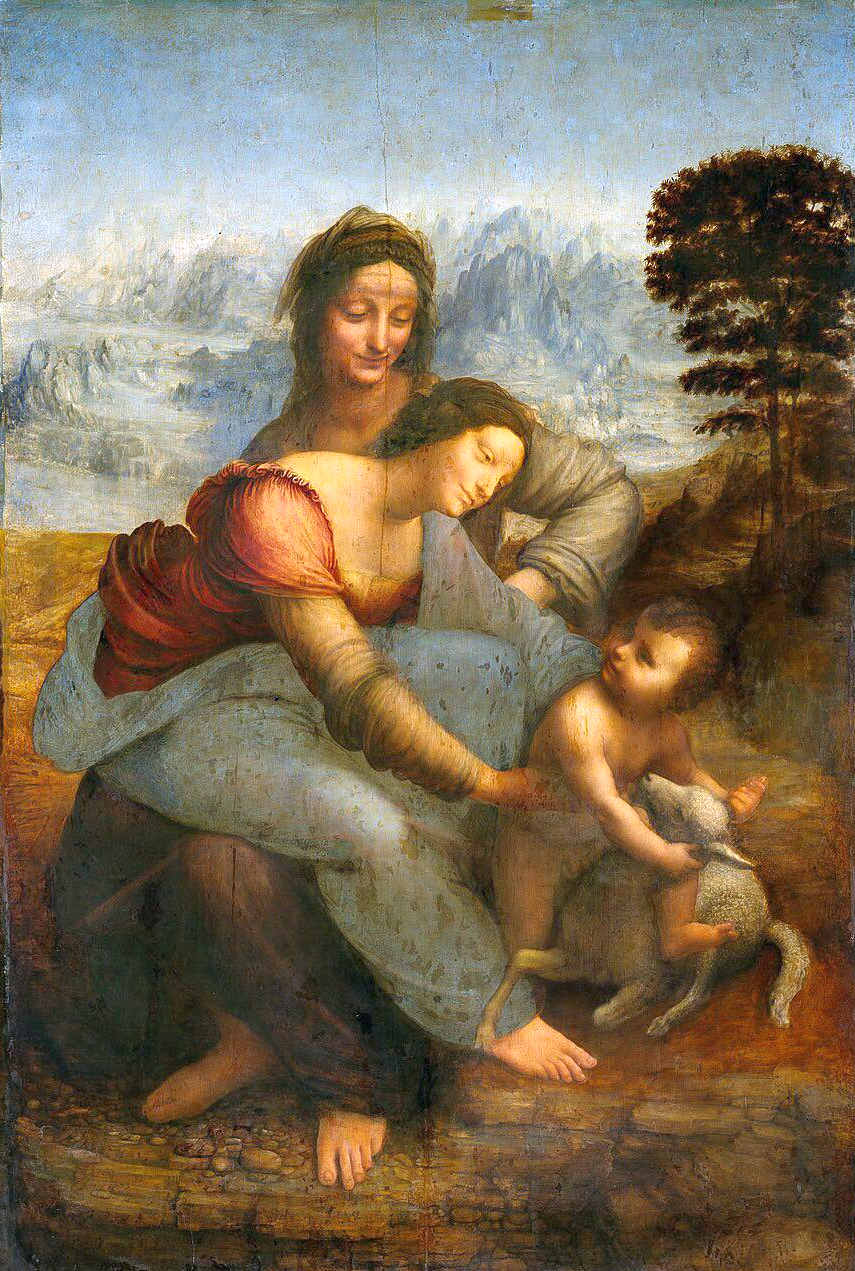
Leonardo da Vinci, Italian, 1452–1519, born in Vinci, Republic of Florence
The Virgin and Child with Saint Anne, c. 1503–1519
Oil on panel
168 × 130 cm
Musée du Louvre, Paris
History of the Painting
Leonardo da Vinci spent many years developing the composition now known as The Virgin and Child with Saint Anne. Preparatory drawings and a large cartoon for the design are documented in Florence around 1500–1501, and the painting itself remained in progress for a long period, probably until the final decade of the artist’s life.
The painting was later acquired for the French royal collection during the reign of King Francis I in the early sixteenth century. It eventually entered the holdings of the Louvre Museum in Paris, where it remains today as one of the most admired works of the Italian Renaissance.
Composition and Symbolism
The painting presents a three-generation grouping: Saint Anne, the mother of the Virgin Mary; the Virgin Mary; and the Christ Child. The Christ Child interacts with a lamb, which in Christian symbolism represents the Passion and the sacrificial destiny of Christ.
Leonardo organized the figures in a pyramidal arrangement, a compositional structure he explored repeatedly in his mature works. The interaction among the figures forms a flowing spiral movement, reflecting Leonardo’s fascination with harmonious geometry and balanced composition.
Leonardo’s Technique
The work demonstrates several technical innovations associated with Leonardo’s later career. The figures are unified through delicate transitions of light and shadow created through layers of oil glazes. This technique produces the soft tonal transitions known as sfumato, one of Leonardo’s most famous painting methods.
Behind the figures stretches a distant landscape of rocky formations and bluish mountains. This background uses atmospheric perspective, a technique Leonardo studied scientifically through his research on optics and the behavior of light in the atmosphere.
Leonardo da Vinci
Leonardo da Vinci was born in the Tuscan town of Vinci in 1452. He trained in Florence in the workshop of the renowned artist Andrea del Verrocchio. During his career he worked in several Italian cities including Florence, Milan and Rome before spending his final years in France under the patronage of King Francis I.
In addition to painting, Leonardo was deeply interested in engineering, anatomy, mathematics and natural science. His notebooks contain thousands of sketches and observations that reveal his extraordinary curiosity about the natural world.
How to See the Painting
Visitors can see The Virgin and Child with Saint Anne at the Louvre Museum in Paris. The painting is displayed in the museum’s Italian Renaissance painting galleries along with other masterpieces by Leonardo da Vinci and his contemporaries.
Because the Louvre is one of the most visited museums in the world, it is recommended to arrive early in the day or book tickets in advance to avoid long waiting lines. Guided tours can also help visitors better understand the history and artistic significance of the painting.
Louvre Museum Entrance Information
The Louvre Museum is located in central Paris along the banks of the Seine River. The main entrance is through the famous glass pyramid in the museum courtyard.
- Location: Musée du Louvre, Paris, France
- Main Entrance: Louvre Pyramid
- Opening Hours: Usually 9:00 AM – 6:00 PM (hours may vary)
- Closed: Tuesdays
Tickets can be purchased online or directly at the museum. Many travelers combine their visit with guided tours that include highlights such as Leonardo da Vinci’s Mona Lisa, the Venus de Milo, and other masterpieces of European art.